
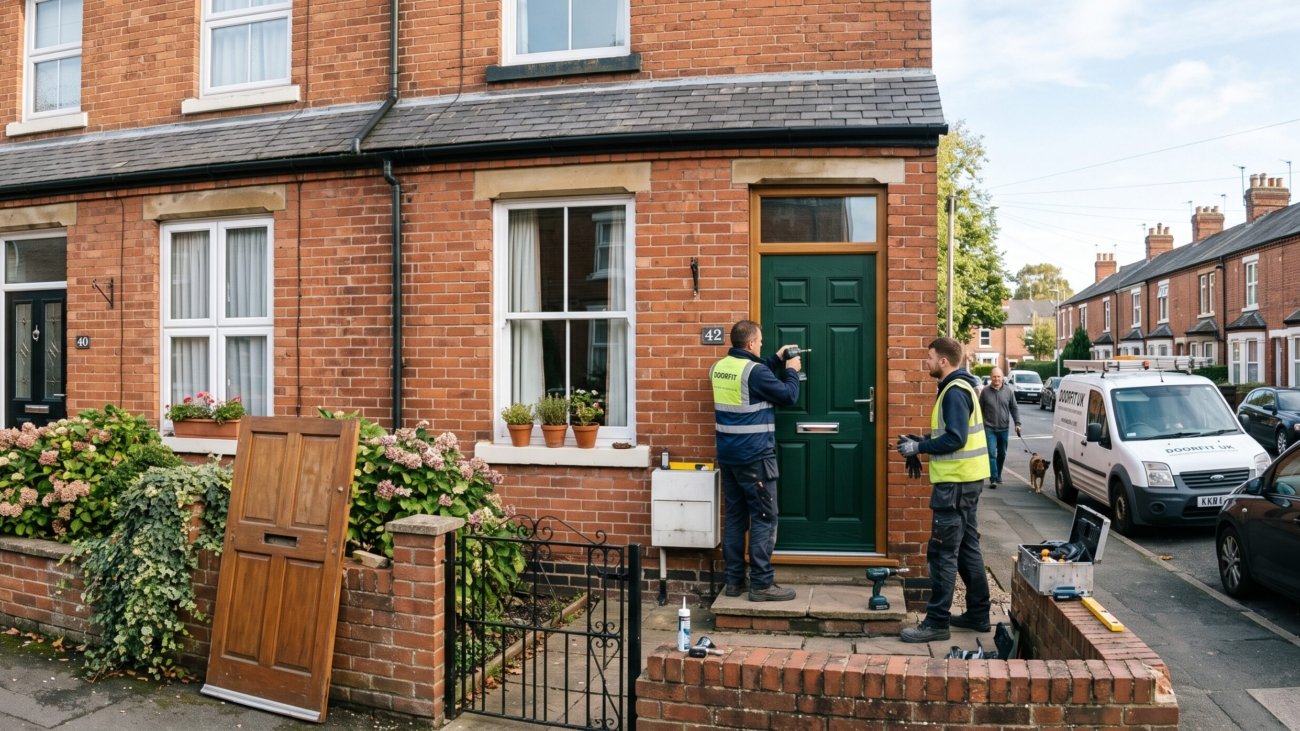
Front Door Installation Checklist - Fitting team installing a new front door on a British terraced house

Front Door Installation Checklist: What Homeowners Need to Know Before Fitting Day

Front Door Installation Checklist: What Homeowners Need to Know Before Fitting Day

A new front door is one of those jobs that feels simple right up until fitting day arrives and you realise you have questions: what happens to the old door, how long will you be without a working lock, does the installer need access all day? Getting your front door installation right the first time saves you money, hassle, and the risk of a poorly sealed door letting draughts straight into your hallway all winter.

This checklist walks through everything to sort out before, during, and after fitting day, plus current 2026 UK pricing so you know what to expect.

Before You Book: What to Sort Out First

Start by getting at least three written quotes from local installers, all specifying the same door style, glazing, colour, and lock standard so you are genuinely comparing like for like. Measure your existing opening yourself beforehand too, it helps you sense-check quotes and spot anything unusually cheap or expensive.

Confirm your installer is FENSA or CERTASS registered. This matters more than it might seem, since registered installers self-certify compliance with building regulations and issue you a certificate, which you may need when you come to sell the property.

Choosing Your Front Door Installation Specification

Decide early on the door material (uPVC, composite, or timber), the glazing style, and crucially the lock. For any front door, ask specifically for a TS007 3-star anti-snap cylinder as standard, not an upgrade option. This single detail has a bigger impact on your home’s security than almost any other decision you will make on the job.

2026 Front Door Installation Cost Guide

JobTypical 2026 UK price
Standard uPVC front door, supplied and fitted£800 – £1,400
Composite front door, supplied and fitted£1,200 – £2,000
Timber front door, supplied and fitted£1,200 – £3,000+
TS007 3-star anti-snap cylinder, fitted£95 – £190
Frame rebuild or brickwork repair (if needed)£150 – £600 extra

Most standard front door replacements take three to five hours for an experienced fitting team, though jobs involving sidelights, structural changes, or frame repairs can take a full day.

Your Front Door Installation Day Checklist

  1. Clear the porch and immediate hallway area so the fitting team has room to work.
  2. Remove any doormats, plant pots, or decorations near the door.
  3. Plan to be home, or arrange for someone to be, for the duration of the fitting.
  4. Keep pets secured in another part of the house during the job.
  5. Ask the installer to confirm the frame will be properly sealed and insulated around the edges, not just screwed into the existing opening.
  6. Test the new lock and all keys before the installer leaves, and confirm how many keys are included.
  7. Ask for your FENSA or CERTASS compliance certificate, this should arrive within a few weeks if not on the day.

A Real-World Example: A First-Time Buyer’s Front Door

Consider a first-time buyer who moved into a 1960s terrace with an original, draughty front door that no longer closed flush with the frame. She got three quotes, all for a standard uPVC door with a TS007 anti-snap cylinder, and chose a mid-priced installer at £980 after checking their FENSA registration and reading independent reviews. On the day, the team cleared the old door and frame, rebuilt a slightly rotten section of timber sub-frame at no extra cost since it was flagged during the initial site visit, and had the new door fitted and tested within four hours. She said the difference in the hallway’s warmth was noticeable within the first cold snap that winter.

Tips to Avoid Common Front Door Installation Problems

  • Get your quotes in writing, including exactly what is and is not included (disposal of the old door, making good to brickwork, and so on).
  • Never accept an unusually low quote without checking what standard of lock and glazing it actually includes.
  • Ask how the installer will protect your floors and hallway walls during fitting.
  • Confirm the guarantee length on both the door itself and the fitting workmanship, these are often different.
  • If you are also having door lock installation done as a separate job, make sure the locksmith and door installer are not duplicating work.

What Happens After Fitting Day

Once the door is in and the team has left, it is worth spending a few minutes doing your own checks rather than assuming everything is perfect. Open and close the door several times to make sure it swings smoothly without catching on the frame or floor. Check that the multipoint locking system engages fully at every point when you turn the key, not just at the top and bottom. Run a hand around the frame edges on a windy day, or simply feel for draughts, since a properly insulated and sealed frame should not let noticeable cold air through.

Keep your paperwork somewhere safe, including the invoice, the guarantee documents, and your FENSA or CERTASS certificate. You may not need them for years, but if you come to sell the property, having proof of a compliant, professionally fitted front door installation can smooth the conveyancing process considerably.

Frequently Asked Questions

How long does front door installation take?

A standard replacement typically takes three to five hours for an experienced two-person team, though frame repairs or structural changes can extend this to a full day.

Do I need to be home for front door installation?

Yes, someone needs to be present throughout, both to grant access and to check and test the finished door, including the new lock and keys, before the installer leaves.

What should be included in a front door installation quote?

A proper quote should specify the door material, glazing type, lock standard, removal and disposal of the old door, making good to the surrounding frame or brickwork, and the guarantee terms for both the door and the fitting.

Final Thoughts

A little preparation before fitting day, and a checklist to work through on the day itself, makes the difference between a smooth front door installation and an expensive surprise. Getting the lock specification right matters just as much as the door itself.

Design Glaze has been installing front doors for homeowners across Wolverhampton and the surrounding towns for over five years. Get in touch for a no-obligation site assessment and a clear, itemised quote before you commit to fitting day.
Design Glaze - Hign quality installations of Windows and doors in Wolverhampton UK

How Much Does uPVC Door Installation Really Cost? A 2026 Homeowner’s Price Guide

How Much Does uPVC Door Installation Really Cost? A 2026 Homeowner’s Price Guide

If your uPVC door has started to stick, let in draughts, or just looks tired next to a freshly painted porch, you are probably wondering what a replacement is really going to cost. It is one of the most common questions we hear from homeowners across Wolverhampton and the surrounding towns, and the honest answer is: it depends on more than most price lists let on. This guide walks through real 2026 uPVC door prices, what pushes the cost up or down, and how to budget sensibly before you get quotes.

Getting this right matters for more than your bank balance. A properly fitted uPVC door affects how warm your hallway feels in January, how safe your family feels at night, and how much your home is worth if you ever decide to sell.

uPVC Door Prices in 2026: The Real Numbers

Across the UK in 2026, a standard uPVC front or back door, fully supplied and fitted, typically costs somewhere between £700 and £1,400. Where you land in that range depends mainly on the door style, the glazing, and the hardware you choose.

A basic, solid panel uPVC door with no glazing sits at the lower end, often £400 to £800 installed. Once you add decorative glazing, upgraded security hardware, or a colour finish instead of plain white, prices climb towards £1,200 to £1,800. Supply-only doors are cheaper again, starting from around £250 for a plain panel and rising to £725 or more for a fully glazed design, but you will still need to budget for a professional fitter.

What Pushes the Price Up

A few factors consistently make the biggest difference to your final bill:

  • Glazing: Decorative or frosted glass panels typically add £100 to £400 to the supply cost.
  • Frame condition: If the existing frame is rotten or out of square, expect an extra £150 to £400 for rebuilding or packer work.
  • Colour: Plain white is the cheapest finish. Woodgrain effects or anthracite grey typically add 10 to 20 percent.
  • Security upgrades: Moving to an anti-snap, three-star rated cylinder and reinforced multipoint locking adds a modest amount but is well worth it (more on this below).
  • Location: Labour-only day rates vary from around £40 an hour in some regions to £300 a day in London and the South East. The West Midlands generally sits comfortably in the middle of the national range.

Don’t Forget Door Lock Installation Costs

Many homeowners focus entirely on the door itself and forget that the lock is doing most of the actual security work. This is where door lock installation becomes just as important as the door slab.

A basic euro cylinder replacement costs from around £25 to £95 for parts and fitting, but a basic cylinder offers very little resistance to a technique called lock snapping, which can force a standard uPVC door open in under a minute. An anti-snap, three-star rated cylinder that meets the TS007 British Standard costs more, typically £95 to £190 fully fitted, but it is one of the most cost-effective security upgrades you can make to any uPVC door. Many UK home insurance policies now expect this standard as a minimum for external doors, so it is worth checking your policy wording before you settle for a basic cylinder.

If you are replacing the whole door, ask your installer to confirm that the multipoint locking system and cylinder meet TS007 3-star or Secured by Design standards as standard, not as an optional extra.

2026 uPVC Door Cost Breakdown

Door type / jobTypical 2026 UK price (supplied and fitted)
Solid panel uPVC door (no glazing)£400 – £800
Standard glazed uPVC front door£700 – £1,400
Decorative or coloured glazed uPVC door£1,200 – £1,800
Basic euro cylinder replacement£25 – £95
Anti-snap TS007 3-star cylinder, fitted£95 – £190
Frame repair or rebuild (if required)£150 – £400 extra

These figures include VAT and are based on typical UK installer quotes in 2026. Always get at least three quotes from local, FENSA-registered installers before committing, since prices can vary noticeably between companies for the same specification.

A Real-World Example: The Hendersons’ Back Door

Picture a young family in a 1980s semi just outside Wolverhampton. Their back door, original to the house, had swollen with damp and no longer locked properly at the top corner. They got three quotes for a standard glazed uPVC replacement with an anti-snap cylinder and multipoint locking. The middle quote came in at £950 fully fitted, including removal of the old door and frame, a half-day job completed in a single visit. Six months on, they say the hallway feels noticeably warmer and they no longer worry about the door rattling in high winds. For them, the extra £150 over the cheapest quote bought a slightly heavier profile and a better guarantee, a trade-off that felt worthwhile for a door they plan to live with for the next fifteen years.

A Homeowner’s Checklist Before You Book Fitting Day

  1. Get at least three written quotes, all specifying the same glazing, colour, and lock standard so you are comparing like for like.
  2. Confirm the installer is FENSA or CERTASS registered so you receive a compliance certificate for building regulations.
  3. Ask specifically whether the cylinder is TS007 3-star rated, not just “multipoint locking”.
  4. Check what happens to the old door and frame, removal and disposal should usually be included.
  5. Ask about the guarantee length on both the door slab and the fitting workmanship separately.
  6. Measure your existing opening before quotes arrive so you can spot unrealistic estimates early.

Frequently Asked Questions

How much does a uPVC door cost fully installed in 2026?

Most homeowners pay between £700 and £1,400 for a standard glazed uPVC door supplied and fitted, with basic unglazed panel doors starting around £400 and premium decorative designs reaching £1,800 or more.

Is it worth upgrading the lock when fitting a new uPVC door?

Yes. A TS007 3-star anti-snap cylinder typically adds under £100 to the job but significantly improves resistance to forced entry, and many insurers now expect this standard on external doors.

How long does uPVC door installation take?

A straightforward replacement usually takes three to five hours for an experienced two-person team, though jobs involving frame repairs or brickwork can take longer.

Final Thoughts

A new uPVC door is one of those jobs that pays you back every day, in warmth, in security, and in how welcoming your home feels the moment you walk up to it. Getting accurate, comparable quotes is the single best thing you can do to avoid overpaying or under-specifying the lock.

Design Glaze has been supplying and installing uPVC doors and windows for homeowners across Wolverhampton and the surrounding towns for over five years. If you would like a no-obligation, on-site assessment and a clear, itemised quote for your uPVC door, get in touch and we will talk you through your options honestly, no pressure, no jargon.

Front Door Installation for Commercial Properties Guide

Guide: Front Door Installation for Commercial Properties

Front Door Installation for Commercial Properties: What to Expect and How Long It Takes

Front door installation for a commercial property is a different job to a straightforward domestic swap. There’s typically more at stake, tighter security requirements, business hours to work around, and often more than one door involved. This guide covers what actually happens during a commercial front door installation, realistic 2026 UK timeframes, and what tends to catch business owners out when budgeting for the work.

Why Commercial Front Door Installation Is Different to a Domestic Job

A standard residential front door installation is usually a single, self-contained job. Commercial installations bring in a few extra variables that change how the work needs to be planned:

  • Business continuity. A shop, office, or restaurant can’t simply close for the day, so installation often needs to work around trading hours or be scheduled outside peak footfall.
  • Higher security specification. Commercial premises typically need certified locking systems and, in many cases, PAS 24 rated doorsets, which affects both the product spec and the installation process.
  • Multiple access points. Many commercial properties need more than one door addressed at once: the front entrance, staff access, and fire exits, which changes the scheduling and sequencing of the job.
  • Compliance requirements. Accessibility, fire regulations, and Building Regulations Part L (thermal performance) all apply differently to commercial premises than to a private home.

What to Expect During Front Door Installation

1. Site Survey and Measurement

Before any door is ordered, a proper site survey checks the condition of the existing opening, confirms measurements, and flags anything that might complicate the job, such as a warped or out-of-square frame. Skipping this step is one of the most common reasons commercial quotes end up higher than expected once work begins.

2. Removal of the Existing Door

The installer removes the old door and inspects the frame underneath. If the frame is in good condition, it can often be reused. If it’s damaged, rotten, or no longer square, a full frame replacement is usually recommended rather than fitting a new door into a compromised opening.

3. Fitting the New Door and Frame

The new door is fitted, checked for level and alignment, and the perimeter is sealed to prevent draughts and water ingress. For commercial installations, this stage also typically includes fitting a multi-point locking system and any additional security hardware specified for the premises.

4. Testing and Final Checks

A thorough installation ends with testing every locking point, checking the door swings and closes correctly, and confirming the seal around the frame is complete. For commercial jobs, this is also when compliance documentation, such as FENSA certification for Building Regulations, gets finalised.

How Long Does Front Door Installation Take?

For a single, straightforward door replacement where the existing opening is in good condition, most professional installers complete the job in three to six hours. If the frame needs replacing as well, or the opening requires remedial work, the job can extend to a full day.

Commercial jobs involving multiple doors, higher-specification security hardware, or work scheduled around trading hours typically take longer overall, not because any single door takes more time, but because of the added planning and sequencing involved. A business replacing both a main entrance and a staff access door, for example, should budget for the job to be spread across more than one visit if trading hours don’t allow both to be tackled at once.

What Affects the Cost of Commercial Front Door Installation

Cost FactorTypical Impact
Door material (uPVC, composite, aluminium, steel)Ranges from budget uPVC to premium steel or aluminium
Frame conditionRebuilding or packer work adds to labour if the existing frame is damaged
Security specificationMulti-point locking and PAS 24-certified doorsets add to both product and labour cost
GlazingDecorative, frosted, or triple-glazed panels increase supply cost
Number of doorsMultiple access points increase both material and labour costs
Access and schedulingWork outside standard hours or around trading requirements can affect labour pricing

As a general benchmark, a single external door installation typically costs between £800 and £2,500 fully fitted in the UK, with commercial-specification hardware, larger doorsets, or multiple doors pushing the total higher.

Door Lock Installation for Commercial Premises

Door lock installation is often bundled into a front door installation project, but it’s worth understanding on its own terms, particularly for commercial premises where the wrong lock specification is a genuine security risk.

  • Multi-point locking systems are now standard on quality commercial doorsets, engaging several points around the frame rather than relying on a single latch.
  • TS007 3-star or Sold Secure Diamond-rated cylinders offer meaningfully better resistance to snapping, picking, and drilling than a basic euro cylinder.
  • Access control integration is increasingly common for commercial entrances, with keypad, fob, or app-based systems fitted alongside or instead of traditional keyed locks.

Specifying the lock at the same time as the door, rather than as an afterthought, avoids the common mistake of pairing a high-specification door with locking hardware that undermines its security rating.

Tips for a Smooth Commercial Installation

  1. Book a site survey before you budget. Frame condition is one of the biggest hidden cost variables, and a survey avoids nasty surprises once the job is underway.
  2. Plan around trading hours. Ask your installer how they sequence work for occupied commercial premises, and whether early morning or after-hours installation is an option.
  3. Confirm certification upfront. For commercial premises, ask whether the installer is FENSA or CERTASS registered, which allows self-certification against Building Regulations.
  4. Specify the lock alongside the door. Don’t leave locking hardware as a late decision. Match the certification of the lock to the certification of the door.
  5. Ask about lead times. Stock colours and standard doorsets typically ship within a few weeks, while bespoke colours or premium security specifications can take considerably longer, so order early if you’re working to a deadline.

A Practical Example

A dental practice in the Wolverhampton area needed both its main entrance and a rear staff door replaced ahead of a lease renewal inspection. The main entrance was scheduled for early morning, before opening hours, to avoid disrupting patients, while the staff door was completed later the same day once the practice had closed. Both doors were fitted with TS007 3-star rated multi-point locks and PAS 24 certified doorsets, with FENSA certification issued on completion, giving the practice documented compliance ahead of its lease review without a single day of lost trading.

Frequently Asked Questions

How long does front door installation take for a commercial property? A single, straightforward installation typically takes three to six hours. Jobs involving frame replacement, multiple doors, or scheduling around trading hours usually take longer overall.

Do commercial premises need a specific type of door lock? There’s no single legal requirement, but multi-point locking systems and TS007 3-star or Sold Secure Diamond rated cylinders are widely recommended for commercial premises, particularly for ground-floor entrances.

Can front door installation happen without closing the business? Yes, in most cases. Installers experienced with commercial projects can often schedule work around trading hours, early mornings, or after-hours to minimise disruption.

Final Thoughts

Front door installation for a commercial property involves more moving parts than a typical domestic job, from security specification to scheduling around trading hours. Understanding the realistic timeframes and cost drivers upfront makes it far easier to budget accurately and avoid the kind of last-minute surprises that derail a project.

Design Glaze carries out front door installation and door lock installation for commercial clients across Wolverhampton and neighbouring cities, with over 5 years of experience scheduling work around live trading businesses. Get in touch for a site assessment and a no-obligation quote.